Formulated by Accredited Practising Dietitians
Creatine for women
three blends to choose from
3 g of 99.9% pure creatine monohydrate in every serve

Formulated by Accredited Practising Dietitians
three blends to choose from
3 g of 99.9% pure creatine monohydrate in every serve
Choose on what comes with it, and on how you want it to taste.
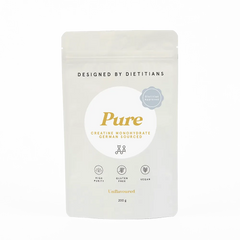
For the coffee, smoothie or shake you already make. Unflavoured, with nothing in it but creatine.
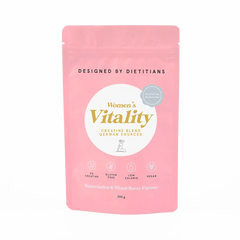
One drink instead of four: creatine, magnesium, zinc and iodine, in watermelon berry with organic maca.
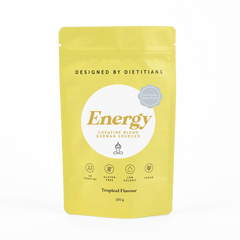
Pineapple mango, with about half an espresso of caffeine. For when you need a push to get started.
Free shipping on Australian orders over $150 · Subscribe and save 10%
The creatine does is the same in all three blends.
| Feature |  Pure Creatine |  Women's Vitality Creatine Blend |  Energy Creatine Blend |
|---|---|---|---|
| Best for | The cheapest per serve, and it will not change the taste of whatever you put it in. | Replaces a small stack rather than adding to it, if you are already buying minerals separately. | For a walk, a session or the school run. The caffeine makes it a morning drink, not an evening one. |
| Creatine per serve | 3 gCreapure® | 3 gGerman sourced | 3 gCreapure® |
| Flavour | Unflavoured | Watermelon berry | Pineapple mango |
| What else is in it | Nothing else |
|
|
| Caffeine | None | None | 50 mgAbout half an espresso |
| Sugars per serve | 0 g | 3.9 g | 3.5 g |
| One serve is | 1 scoop (3 g) | 2 scoops (10 g)in 300 mL cold water | 2 scoops (8 g)in 300 mL cold water |
| Serves per pack | 66 | 20 | 25 |
| Price | $47.99$0.72 per serve | $36.99$1.85 per serve | $36.99$1.48 per serve |
| Buy | See details Pure Creatine | See details Women's Vitality Creatine Blend | See details Energy Creatine Blend |
Swipe the table to compare all three
Prices include GST. Australian orders over $150 ship free. Full ingredients and the nutrition information panel are on each product page.
The four things women ask us before they buy creatine. We would rather answer them here than have you go looking.
Women synthesise about 20% less creatine than men, and take in 30 to 40% less from food, largely because red meat is the main dietary source. Your muscles use creatine to regenerate ATP, the molecule you spend on short, hard effort, which is why it supports strength and performance. Creatine is one of the most studied supplements there is, and the women-specific research is the newest part of it.
The clearest women-specific finding is in bone. A twelve-month trial in postmenopausal women taking creatine alongside supervised resistance training saw less bone mineral density lost at the femoral neck than the placebo group. A separate trial that gave creatine without the training found no bone benefit at all. The training is doing real work in that sentence and we are not going to pretend otherwise.
Three grams a day, every day. Not half a scoop because you are a woman, and not five grams because a label somewhere says so.
Three grams is the amount the International Society of Sports Nutrition describes taking daily for four weeks in place of a loading phase, it is the daily intake the European Union attaches its authorised creatine claim to, and it is the maximum that may be added to a one-day serve of a sports food under the Australia New Zealand Food Standards Code.
Pure Creatine is one 3 g scoop. Women's Vitality is two scoops, 10 g of powder with 3 g of creatine in it. Energy is two scoops, 8 g of powder with 3 g of creatine in it.
Yes, every day including rest days.
Creatine works by keeping your muscles topped up, and that is a matter of taking it consistently rather than timing it around a session. Most people attach it to something they already do: the morning coffee, the smoothie, the drink after a walk. Missing the occasional day will not undo anything.
In people with healthy kidneys, the research says no.
The concern starts from something real. Creatine breaks down into creatinine, and creatinine is the number a standard blood test uses to estimate how well your kidneys are filtering. Take creatine daily and that number goes up. What has changed is the marker, not the kidney.
A 2026 review in International Urology and Nephrology pooled 26 trials and 1,036 people. Serum creatinine rose, and the eGFR calculated from it fell. But when filtration was measured directly rather than estimated from creatinine, there was no difference. The authors concluded the findings “likely reflect altered creatinine metabolism rather than kidney injury”. A second 2026 review, of randomised trials only, found the same.
One honest limit on that. Most of these trials ran for weeks or months rather than years, so evidence past the one year mark is still thin.
And none of it speaks for you if your kidneys are not healthy to begin with. If you have kidney disease or reduced kidney function, or you take medication that affects your kidneys, talk to your doctor before you start rather than after a blood test.
If your kidneys are healthy and you are taking 3 to 5 g a day, the evidence is reassuring. The most likely thing that happens is a blood test that looks worse than you are, and that one is answered next.
Almost certainly because the test uses creatinine, and creatine raises it. In someone with healthy kidneys, that lower number is a false red flag rather than a change in your kidneys.
Your GP does not measure your kidney function directly. They measure serum creatinine and run it through a formula, along with your age and sex, to produce an estimated glomerular filtration rate. Creatine breaks down into creatinine, so supplementing raises the input to that formula, and because the relationship is inverse, a higher creatinine gives a lower eGFR. The number on the report drops and nothing has happened to your kidneys.
It helps to know how big the effect is. Across 26 pooled trials, creatine lowered creatinine based eGFR by around 10 mL/min. That is easily enough to take a normal result below a reference range and give you a fright. It is nowhere near enough to explain a result that is badly abnormal. If your eGFR has dropped a long way, or it is falling from one test to the next, please do not file it under “it is just the creatine”. That one needs looking at properly.
What to do:
And the part that matters most. All of the above describes someone with normal kidney function. If you have kidney disease, or your doctor is already monitoring your kidneys for any reason, an abnormal result is not something to explain away. Speak to them first.
This one now has a direct answer.
A 2025 randomised controlled trial gave 5 g a day for twelve weeks and measured dihydrotestosterone, total and free testosterone, and hair density, count and thickness. Nothing changed on any of those measures.
Because creatine monohydrate genuinely does not dissolve well in cold water. Some settling at the bottom of the glass is normal, and it does not mean the product is faulty or that you are missing the dose.
Stir it again before the last mouthful, or use slightly warmer liquid. In a smoothie, coffee or protein shake you will not notice it at all.
Any of the three. They all deliver the same 3 g of creatine, so choose on flavour, on whether you want the extra minerals in Women's Vitality, and on whether caffeine suits you.
We should be straight with you about the evidence, though. There are no creatine trials in perimenopause specifically. The women-specific research that does exist is mostly in postmenopausal women, and the clearest result in it came from creatine taken alongside resistance training.
Not without talking to your healthcare professional first. There is limited research on creatine supplementation during pregnancy and breastfeeding, and all three products carry the mandatory sports-food statement that they are not suitable for pregnant women.
All three are gluten free. Every panel returns Nil Detected, and none of them contains dairy or soy.
And yes. Our blends are formulated with women in mind, but creatine is creatine. They work exactly the same way for men.
Anyone under 15, and anyone who is pregnant, as stated on the pack. Talk to your healthcare professional first if you have an existing kidney or liver condition, or if you take medication that affects kidney function such as diuretics or regular anti-inflammatories.
Energy Creatine Blend contains 50 mg of caffeine per serve, so it is not the right one if you are sensitive to caffeine or avoiding it. Pure Creatine and Women's Vitality contain none.
There are more creatine answers, and answers about everything else we make, on the full FAQ page.
For the coffee, smoothie or shake you already make. Unflavoured, with nothing in it but creatine.
One drink instead of four: creatine, magnesium, zinc and iodine, in watermelon berry with organic maca.
Pineapple mango, with about half an espresso of caffeine. For when you need a push to get started.
Free shipping on Australian orders over $150 · Subscribe and save 10%

Debby is an AI nutrition guide, not a dietitian or doctor, so this is general information rather than personal advice. Chats are stored; our Privacy Policy explains how.